biogeography

Reference genomes and fossils revise bat family phylogeny and biogeography
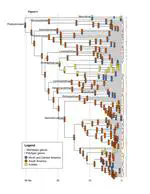
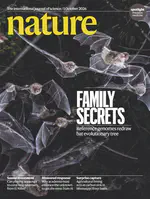
Bats are extraordinary among mammals, having uniquely evolved powered flight and laryngeal echolocation, along with disease resistance, extended healthspans and the ability to hibernate1. However, the evolutionary history of bats and the understanding of these adaptations remain unresolved. We analysed chromosome-level, long-read genome assemblies from 103 bat species, including 42 new assemblies, representing all 21 bat families. This dataset, expanded in scope and assembly quality, yielded a new bat phylogeny. We placed Myzopodidae as the earliest branch within Vespertilionoidea, and resolved yangochiropteran relationships, identifying Emballonuroidea and Vespertilionoidea as sister groups. Our analysis revealed a mosaic evolutionary history across bats and explained why previous phylogenetic studies were misled. Chromosomal ancestral-state reconstructions supported 26 ancestral bat chromosomes. We integrated a morphological dataset of 699 characters for 65 species, including 44 pre-Quaternary fossils and representatives of most living bat families, with neutrally evolving genomic sites. Fossilized birth–death and dispersal–extinction cladogenesis analyses showed that bats, and thus powered flight, probably originated in Europe in the late Palaeocene, refuting African and North American origins. Placement of the fossil †Vielasia in the oldest ‘Eochiroptera’ clade indicates that laryngeal echolocation predates crown-bat diversification. Total evidence dating, including the fossil taxa, significantly reduced unrepresented basal branch lengths compared with molecular-only divergence estimates. By integrating comprehensive genomic and morphological datasets, analysed using innovative methods, we resolve long-standing controversies in bat biology and provide new insights into the evolutionary history and trait diversification of bats.
Short‐faced bats (Phyllostomidae: Stenodermatina): a Caribbean radiation of strict frugivores
Aim To test the hypothesis that Caribbean Short‐faced bats descended from a single recent ancestor that originated in the continental Neotropics (Mexico, Central America and/or South America). Location The Neotropics, including the West Indies. Methods New mitochondrial cytochrome b and nuclear Rag2 sequences were combined with published molecular data to estimate phylogenetic relationships and sequence divergence among Short‐faced bats. The resulting phylogenies were compared with those compatible with the single‐origin hypothesis using two model‐based statistical tests. Confidence limits on sequence divergence were estimated using a parametric bootstrap. Results All molecular phylogenies revealed two independent Caribbean lineages and showed that continental Short‐faced bats share a recent common ancestor. Morphology‐based trees compatible with the single‐origin hypothesis were significantly worse at explaining the molecular data than any molecular phylogeny. Main conclusions The ancestor of all Short‐faced bats reached the Antilles in the Miocene, too recently to have used a proposed Oligocene land bridge, and well before the Pleistocene glaciations that are thought to have facilitated dispersal for many bats. After a long period of isolation, Short‐faced bats diversified quickly on the Caribbean islands. A single Short‐faced lineage then reached the continent and subsequently expanded its range and diversified into the four extant genera. Among bats, independent lineages of aerial insectivores and nectarivores have also recolonized the continent after evolving in the West Indies. The evidence for an insular origin of the short‐faced frugivorous radiation completes a dynamic model of Caribbean biogeography that encompasses an entire biological community.
The geography of diversification in the mormoopids (Chiroptera: Mormoopidae)
The traditional explanation of the distribution of the Mormoopidae is that this family originated in southern Central America or northern South America, later expanding its range north to Mexico and the West Indies, and differentiating into eight species. An alternative fossil-based hypothesis argues that the family originated in the northern Neotropics, reached the Caribbean early in its history, and dispersed to South America after the completion of the Isthmus of Panama. The present study analyses new and previously published sequence data from the mitochondrial 12S, tRNAval, 16S, and cytochrome b, and the nuclear Rag2, to evaluate species boundaries and infer relationships among extant taxa. Fixed differences in cytochrome b often coincide with published morphological characters and show that the family contains at least 13 species. Two additional, morphologically indistinct, lineages are restricted to Suriname and French Guiana. Phylogeny-based inferences of ancestral area are equivocal on the geographical origin of mormoopids, in part because several internal nodes are not resolved with the available data. Divergences between Middle American and Antillean populations are greater than those between Mexico/Central America and South America. This suggests that mormoopids diversified in northern Neotropics before entering South America. A northern neotropical origin for mormoopids is congruent with both the Tertiary fossil record and recent phylogenetic hypotheses for the sister family to the Mormoopidae, the Phyllostomidae.
Phylogeny and biogeography of Caribbean mammals
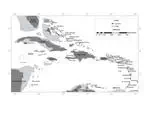
Vicariance and dispersal hypotheses have been proposed over the last two hundred years to explain the distribution, diversity, and faunal composition of the Caribbean biota. Despite great advances in understanding the geological history of the region, recent biogeographical reviews have not used historical biogeographical methods. In this paper I review the taxonomy, distribution and phylogeny of all Cenozoic Caribbean non-volant mammals and four bat lineages, and present reconciled trees for available phylogenies. Dates available from the fossil record and hypotheses of divergence based on molecular phylogenetic studies are also included in general assessments of fit between proposed geological models and Caribbean mammal diversification. The evidence posited in mammalian phylogenies does not add to the argument of dispersal vs. vicariance. One previously unidentified temporal pattern, the colonization of the Caribbean by South American mammals between the Palaeocene and the Middle Miocene, accounts for the distribution and phylogeny of the majority of lineages studied. Choloepodine and megalocnine sloths, hystricognath rodents, and primates all arrived during this window of colonization. Of these, megalocnine sloths, hystricognath rodents, Brachyphylla and allied bats, Stenodermatina bats, and primates fit the pattern of divergence from the mainland implied by the Gaarlandia hypothesis. Sloths, rodents and primates also roughly fit the timing of arrival to the Caribbean implied by Gaarlandia. The remaining taxa show contradictory dates of divergence according to molecular clock estimates, and no taxa fit the predicted timing and pattern of divergence among Antillean landmasses under the Gaarlandia model. Choloepodine sloths, murid rodents, insectivorans, mormoopids, and natalids show patterns of divergence from the mainland that are inconsistent with the Gaarlandia hypothesis and seem to require taxon-specific biogeographical explanations.