Artibeus jamaicensis

Pathogenesis and host response to a novel Tacaribe virus isolate in experimentally-infected Jamaican fruit bats
Tacaribe virus (TCRV) was the first arenavirus discovered in the New World and was isolated from Artibeus bats in Trinidad and Tobago in the 1950s. One isolate, TRVL-11573, remains but it was passaged by intracranial inoculation of newborn mice 22 times that likely changed its biology. This isolate has been extensively used for arenavirus research, including our previous work that showed it can cause fatal neurological disease in Jamaican fruit bats (Artibeus jamaicensis). Another divergent TCRV, DOM2014, was recently identified in transcriptome data from a Jamaican fruit bat captured in the Dominican Republic that contained TCRV genome. A kidney fragment homogenate from this bat was inoculated into Jamaican fruit bats and all became infected with signs of mild liver disease. Experimental challenge of Jamaican fruit bats with DOM2014 led to nonfatal infection that persisted through the end of the study on day 21 and with contact transmission to naive bats. Histopathology, immunohistochemistry and serum chemistry confirmed infection and mild liver disease, but none of the bats produced neutralizing antibodies. B cell receptor transcripts suggested limited somatic hypermutation that could explain the lack of detectable neutralizing antibodies. Transcriptome profiling of livers and spleens showed signatures of a typical innate antiviral response; however, evidence of adaptive immune suppression was also present. Similarly, liver transcriptome analysis showed signatures of an expected innate antiviral response and metabolic dysfunction. The isolation of TCRV DOM2014 provides a relevant model for the study of a bat reservoir host, and which may challenge the extensive work previously conducted with TRVL-11573.
Discovery and biological confirmation of a highly divergent Tacaribe virus in metatranscriptomic data from neotropical bats
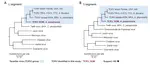
First isolated from neotropical fruit bats in Trinidad in 1956, Tacaribe virus (TCRV) has rarely been detected since. We searched for New World arenavirus reads in roughly 5.7 million sequencing runs available on public databases using Serratus. We recovered a complete genome of a divergent TCRV in metatranscriptomic data derived from heart and eye tissue of an adult male Jamaican fruit-eating bat sampled in the Dominican Republic, 2014. In total, 2,733 reads were mapped resulting in mean coverages of 7.4-fold for the L and 10.2-fold for the S segment. Re-testing original bat specimens showed the highest viral loads in liver tissue (245 copies/mg). Sanger sequencing of PCR amplicons from liver confirmed correctness of and completed the genome recovered from metatranscriptomic data, revealing conserved arenavirus genomic organization, length, intergenic regions, and genome termini. The newly found TCRV strain tentatively named DOM2014 clustered in a basal sister relationship to all other known TCRV strains with which it shared between 83.3%–86.0% genomic and 91.8%–93.7% translated amino acid sequence identity across protein-coding regions. DOM2014 showed a conserved glycine, proline, proline, threonine (GPPT) nucleopro­ tein motif, which is essential for TCRV interferon β antagonism. Our data confirm the association of TCRV with the bat genus Artibeus put into question by lethal experi­ mental infections and scarce bat-derived TCRV genomic data. Broad genetic diversity and geographic spread require assessments of TCRV strain-associated pathogenicity, particularly for DOM2014 as a highly divergent TCRV strain. Confirmation of genomic database findings by testing original specimens provides robustness to our findings and supports the usefulness of metatranscriptomic studies.