Interactions between intrinsic and extrinsic factors shape island bat survival and extirpation in a global extinction hotspot
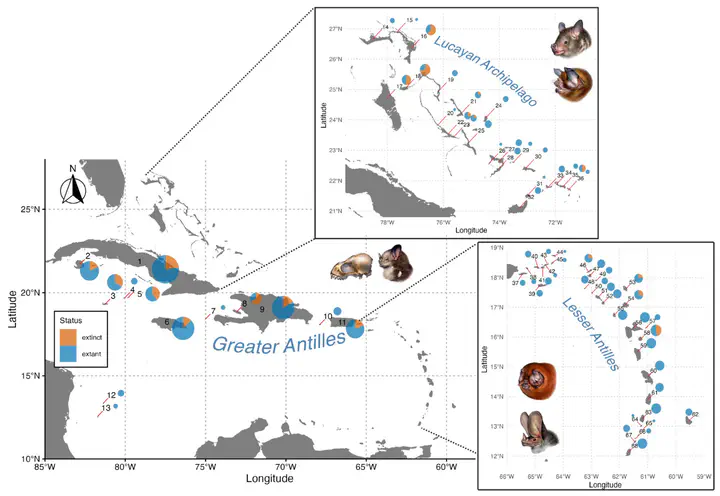 Image credit: K.M. Rayfield
Abstract
Caribbean islands are hotspots of mammalian biodiversity and extinction, as only a few intermediate-sized non-volant species survived. Despite numerous extirpations and extinctions, how body size (intrinsic trait) or island features (extrinsic environmental variables) contribute to the survival and extirpation of 479 bat populations is poorly known. We used phylogenetic hierarchical models to impute missing body mass data for several fossil species and then to model extirpation probability as a function of intrinsic traits and extrinsic variables. We found smaller- and larger-sized bat species survived slightly more than intermediate-sized ones; elevation increased, island size decreased this curvilinear survival probability, and deforestation decreased overall survival. We propose that: 1) flight constrains body size such that bats are prey to introduced species but larger bats can better recolonize islands, yielding a pattern of greater survival at larger sizes, 2) undersampling of small islands and the diversity of introduced species on larger islands explains the interaction with island size, and 3) deforestation reflects centuries of longstanding biotic reconstruction that transformed island landscapes. Our findings highlight the primacy of body mass and its interaction with extrinsic variables in explaining Caribbean bat extirpations with broader implications for island biogeography, evolution, and conservation.