comparative genomics

Reference genomes and fossils revise bat family phylogeny and biogeography
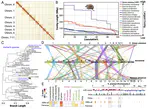
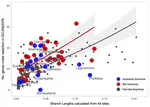
Bats are extraordinary among mammals, having uniquely evolved powered flight and laryngeal echolocation, along with disease resistance, extended healthspans and the ability to hibernate1. However, the evolutionary history of bats and the understanding of these adaptations remain unresolved. We analysed chromosome-level, long-read genome assemblies from 103 bat species, including 42 new assemblies, representing all 21 bat families. This dataset, expanded in scope and assembly quality, yielded a new bat phylogeny. We placed Myzopodidae as the earliest branch within Vespertilionoidea, and resolved yangochiropteran relationships, identifying Emballonuroidea and Vespertilionoidea as sister groups. Our analysis revealed a mosaic evolutionary history across bats and explained why previous phylogenetic studies were misled. Chromosomal ancestral-state reconstructions supported 26 ancestral bat chromosomes. We integrated a morphological dataset of 699 characters for 65 species, including 44 pre-Quaternary fossils and representatives of most living bat families, with neutrally evolving genomic sites. Fossilized birth–death and dispersal–extinction cladogenesis analyses showed that bats, and thus powered flight, probably originated in Europe in the late Palaeocene, refuting African and North American origins. Placement of the fossil †Vielasia in the oldest ‘Eochiroptera’ clade indicates that laryngeal echolocation predates crown-bat diversification. Total evidence dating, including the fossil taxa, significantly reduced unrepresented basal branch lengths compared with molecular-only divergence estimates. By integrating comprehensive genomic and morphological datasets, analysed using innovative methods, we resolve long-standing controversies in bat biology and provide new insights into the evolutionary history and trait diversification of bats.
Genomic comparisons and the adaptive basis of brain size plasticity and chromosomal instability in the Eurasian common shrew
Sorex araneus, the Eurasian common shrew, has seasonal brain size plasticity (Dehnel’s phenomenon) and abundant intraspecific chromosomal rearrangements, but genomic contributions to these traits remain unknown. We couple a chromosome-scale genome assembly with seasonal brain transcriptomes to discover relationships between molecular changes and both traits. Positively selected genes enriched the Fanconi anemia DNA repair pathway, which prevents the accumulation of chromosomal aberrations, and is likely involved in chromosomal rearrangements (FANCI, FAAP100). Genes involved in neurogenesis show either signatures of positive selection (PCDHA6), seasonal differential expression in the cortex and hippocampus (Notch signaling), or both (SOX9), suggesting a role for cellular proliferation in seasonal brain shrinkage and regrowth. Both positive selection and evolutionary upregulation in the shrew hypothalamus of VEGFA and SPHK2 indicate adaptations in hypothalamic metabolic homeostasis have evolved together with Dehnel’s phenomenon. These findings reveal genomic changes central to the evolution of both chromosomal instability and cyclical patterns in brain gene expression that characterizes mammalian brain size plasticity.
Bat genomes illuminate adaptations to viral tolerance and disease resistance
Zoonoses are infectious diseases transmitted from animals to humans. Compared to other mammalian orders, bats are suggested to harbor more zoonotic viruses(Olival et al. 2017). Infections in bats are largely asymptomatic(Schlottau et al. 2020; Guito et al. 2021), suggesting limited tissue-damaging inflammation and immunopathology. To investigate the genomic basis of disease resistance, the Bat1K project generated reference-quality genomes of ten bat species, including potential viral reservoirs. A systematic analysis covering 115 mammalian genomes revealed that signatures of selection in immune genes are more prevalent in bats compared with other mammalian orders. We found an excess of immune gene adaptations in the ancestral chiropteran branch and in many descending bat lineages, highlighting viral entry and detection factors, and regulators of antiviral and inflammatory responses. ISG15, an antiviral gene contributing to hyperinflammation during COVID-19(Perng and Lenschow 2018; Munnur et al. 2021), exhibits key residue changes in rhinolophid and hipposiderid bats. Cellular infection experiments show species-specific antiviral differences and an essential role offor protein conjugation in antiviral function of bat ISG15, separate from its role in secretion and inflammation in humans. Furthermore, in contrast to human ISG15, ISG15 of most rhinolophid and hipposiderid bats has strong anti-SARS-CoV-2 activity. Our work reveals molecular mechanisms contributing to viral tolerance and disease resistance in bats.
Newly assembled pocket gopher genomes can facilitate conservation management of biodiversity
Texas exhibits one of the richest levels of pocket gopher diversity in the United States. Three genera (Cratogeomys, Geomys, and Thomomys) and 11 species are found in Texas. It is not surprising given the diversity of the Texas landscape (ecoregions, life zones, substrates, and vegetation) that these species are further subdivided into 29 subspecies in Texas alone. Pocket gopher distributions are determined by availability of suitable soil types and therefore often occur in small, isolated populations. For some taxa, limited distribution and ultimately small deme sizes result in populations that may require attention from a regulatory and management perspective. For many Texas pocket gopher subspecies, insufficient information exists to make sound recommendations relative to conservation status and needs despite decades of research collecting and evaluating data based on morphometrics, distributions and habitat preferences, karyotypes, allozymes, and mitochondrial DNA. As such, there is precedent for elevating pocket gopher subspecies to species after evaluation of available data, as well as subsuming subspecies into a broader taxonomic group. We used genomic techniques to identify genetically defined operational taxonomic units (OTUs) of pocket gophers to improve knowledge and understanding of pocket gopher distributions within the state. Using tens of thousands of single nucleotide polymorphisms, we determined the number of OTUs in each genus to be 5 for Thomomys bottae subspecies, 8 for Geomys species, and 5 for Cratogeomys castanops subspecies in Texas. In general, these data agree with current taxonomic hypotheses regarding Geomys and C. castanops; however, many T. bottae groups present similar genetic patterns that do not merit subspecies status based on these data, suggesting a more conservative classification of T. bottae in Texas and southeastern New Mexico that could facilitate conservation efforts, should they be necessary.