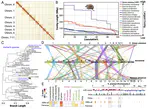
Bats are extraordinary among mammals, having uniquely evolved powered flight and laryngeal echolocation, along with disease resistance, extended healthspans and the ability to hibernate1. However, the evolutionary history of bats and the understanding of these adaptations remain unresolved. We analysed chromosome-level, long-read genome assemblies from 103 bat species, including 42 new assemblies, representing all 21 bat families. This dataset, expanded in scope and assembly quality, yielded a new bat phylogeny. We placed Myzopodidae as the earliest branch within Vespertilionoidea, and resolved yangochiropteran relationships, identifying Emballonuroidea and Vespertilionoidea as sister groups. Our analysis revealed a mosaic evolutionary history across bats and explained why previous phylogenetic studies were misled. Chromosomal ancestral-state reconstructions supported 26 ancestral bat chromosomes. We integrated a morphological dataset of 699 characters for 65 species, including 44 pre-Quaternary fossils and representatives of most living bat families, with neutrally evolving genomic sites. Fossilized birth–death and dispersal–extinction cladogenesis analyses showed that bats, and thus powered flight, probably originated in Europe in the late Palaeocene, refuting African and North American origins. Placement of the fossil †Vielasia in the oldest ‘Eochiroptera’ clade indicates that laryngeal echolocation predates crown-bat diversification. Total evidence dating, including the fossil taxa, significantly reduced unrepresented basal branch lengths compared with molecular-only divergence estimates. By integrating comprehensive genomic and morphological datasets, analysed using innovative methods, we resolve long-standing controversies in bat biology and provide new insights into the evolutionary history and trait diversification of bats.